← Back

Education Technology · 2023

Simplifying Course Discovery Across Diverse Learning Journeys

Led UX discovery and experience optimisation for a School of Lifelong Learning storefront serving both individual learners and corporate customers. Through research, persona development, and journey mapping, the redesign streamlined course discovery, filtering, and enrolment experiences while establishing a stronger foundation for future platform enhancements.

⚠ NDAUX ResearchJourney MappingB2B & B2C ExperienceSalesforce Commerce CloudInformation Architecture
RoleUX Designer
Timeline2023
PlatformWeb · Desktop

Project Overview

Challenge
A shared storefront served two audiences (individual learners and corporate buyers) with fundamentally different goals, decision journeys, and information needs, creating friction for both.
Objective
Improve course discoverability, simplify enrolment journeys, and create a more intuitive experience for both audience types without disrupting the Salesforce Commerce Cloud ecosystem.
Solution
Research-led personas, current and future-state journey mapping, restructured information architecture, and streamlined enrolment flows, all scoped to platform capabilities.
Outcome
Improved discoverability, reduced enrolment friction, stronger audience alignment, and a scalable framework for future storefront enhancements.

The Challenge

Understanding the problem

The platform served two distinct audiences: individual learners searching for professional development opportunities, and organisations seeking training programmes for employees. While both shared access to the same storefront, their goals, decision-making processes, and information needs differed significantly. The challenge was to improve discoverability, simplify enrolment journeys, and create a more intuitive experience, without disrupting the underlying Salesforce Commerce Cloud ecosystem.

Research & Discovery

What we uncovered

Stakeholder interviewsUser research sessionsPersona developmentCurrent-state journey mappingContent & navigation analysis

Key Findings

Course information was difficult to compare and evaluate across programmes
Users struggled to navigate between programmes and learning paths
B2B and B2C users followed fundamentally different decision journeys
Enrolment flows contained unnecessary friction points that interrupted conversion

Strategy & Approach

Design principles

Simplified Discovery
Streamlined course exploration through improved navigation, search, and filtering, reducing the effort required to find and evaluate relevant programmes.
Information Hierarchy
Restructured content presentation to support faster comparison and evaluation, giving users the right information at the right stage of their journey.
Dual Audience Design
Balanced B2B and B2C decision-making journeys without fragmenting the shared storefront, one platform, two coherent experiences.
Platform Alignment
All recommendations scoped to Salesforce Commerce Cloud capabilities, ensuring proposals were implementable within existing infrastructure constraints.

Process

How we got there

01
Research & Discovery
Stakeholder interviews, user research sessions, content and navigation analysis
02
Personas & Journey Mapping
Audience-specific personas and current-state journey maps for both B2B and B2C users
03
Opportunity Identification
Synthesised research into prioritised friction points and experience gaps
04
Information Architecture
Restructured navigation, search, and content hierarchy to support both audience journeys
05
Flow Optimisation
Redesigned enrolment and registration flows to reduce unnecessary steps
06
Wireframes & Prototypes
Low and mid-fidelity prototypes validated against user needs and platform constraints
07
Stakeholder Validation
Iterative reviews with product, marketing, and Salesforce Commerce Cloud implementation teams

Solution

What we built

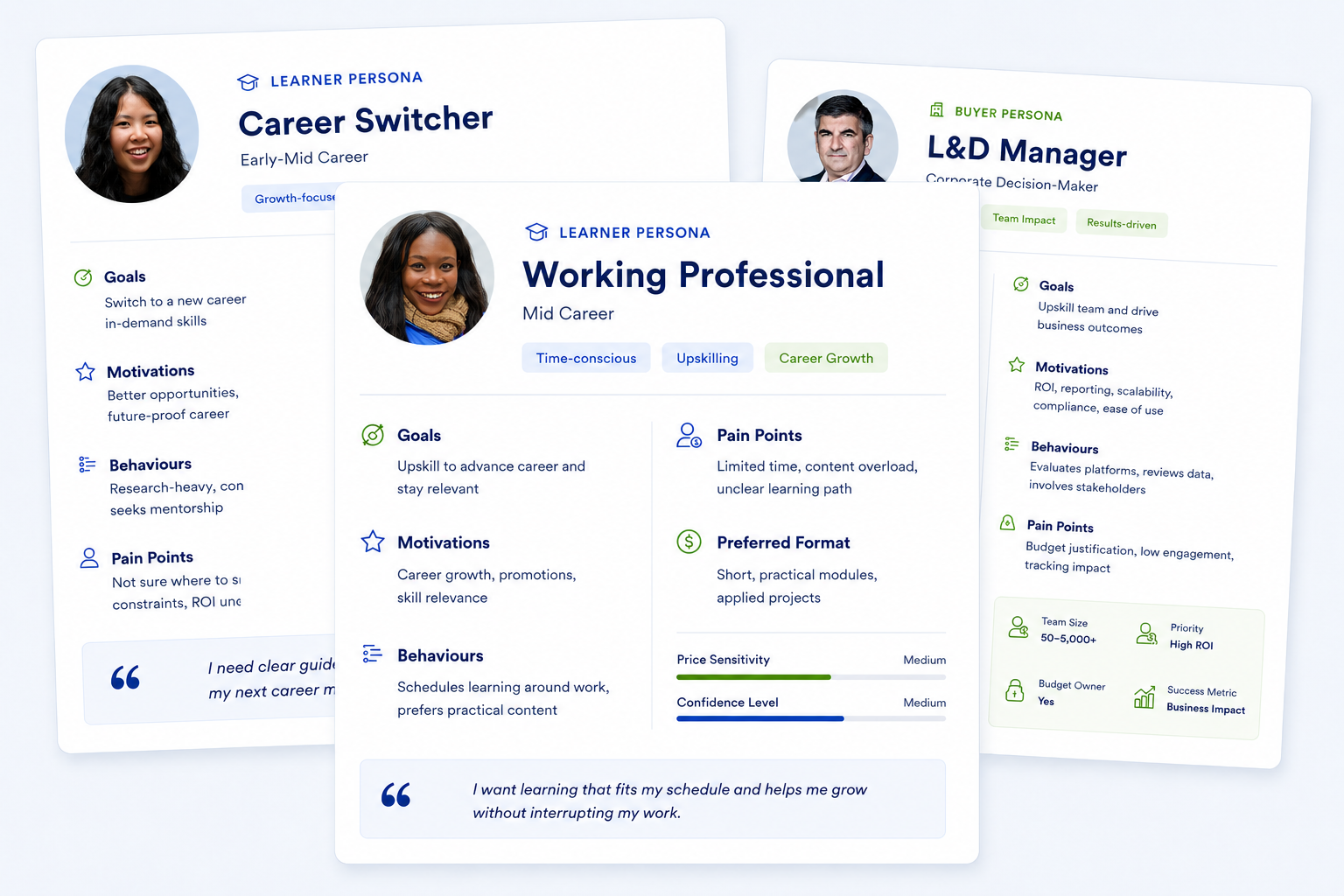
Research-Led Personas

Research-Led Personas

Developed audience-specific personas representing individual learners and corporate decision-makers, grounding every design decision in distinct behavioural and motivational differences.
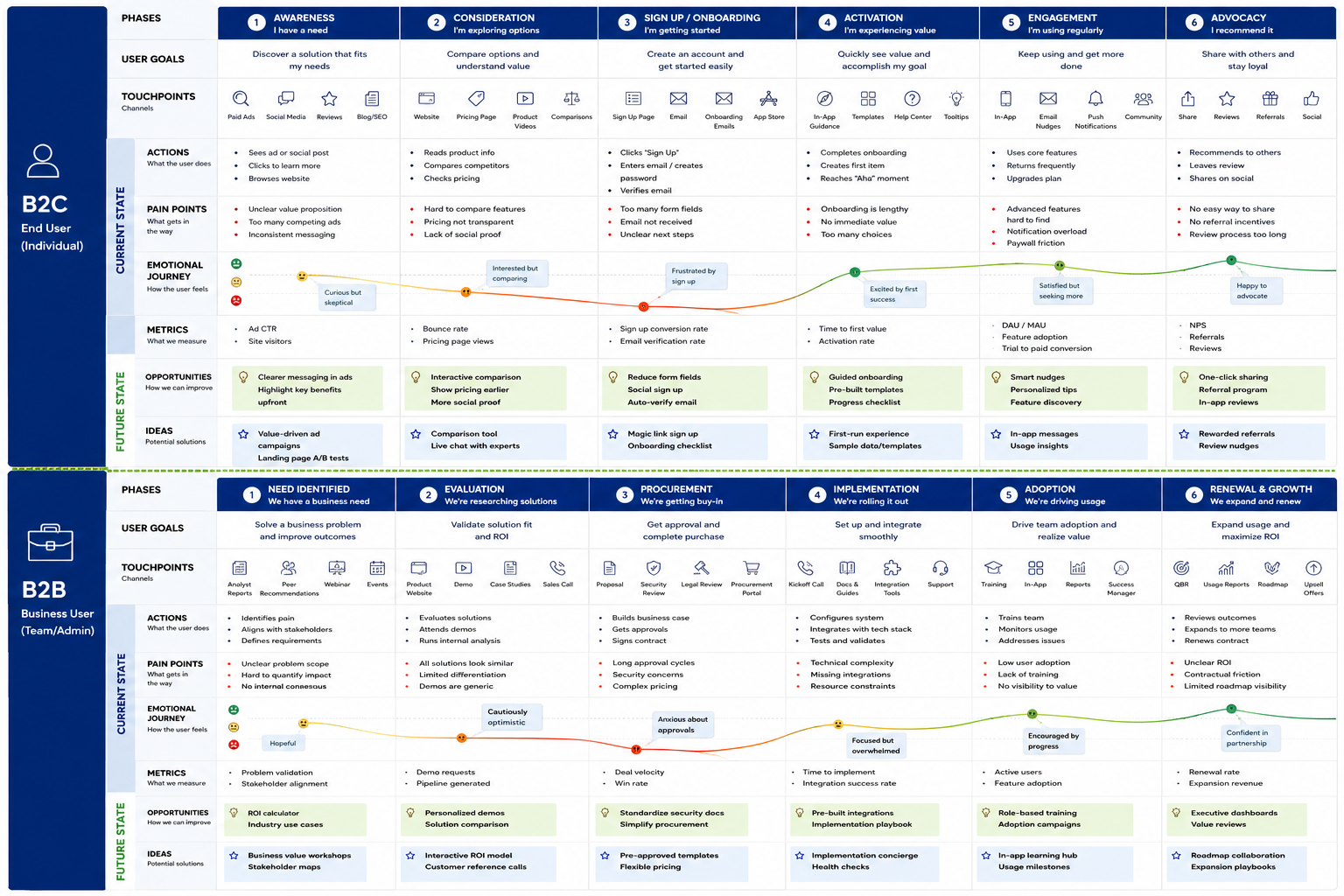
Journey Mapping

Journey Mapping

Mapped current and future-state journeys for both B2B and B2C users to surface pain points, identify opportunity areas, and align stakeholders around a shared understanding of user needs.
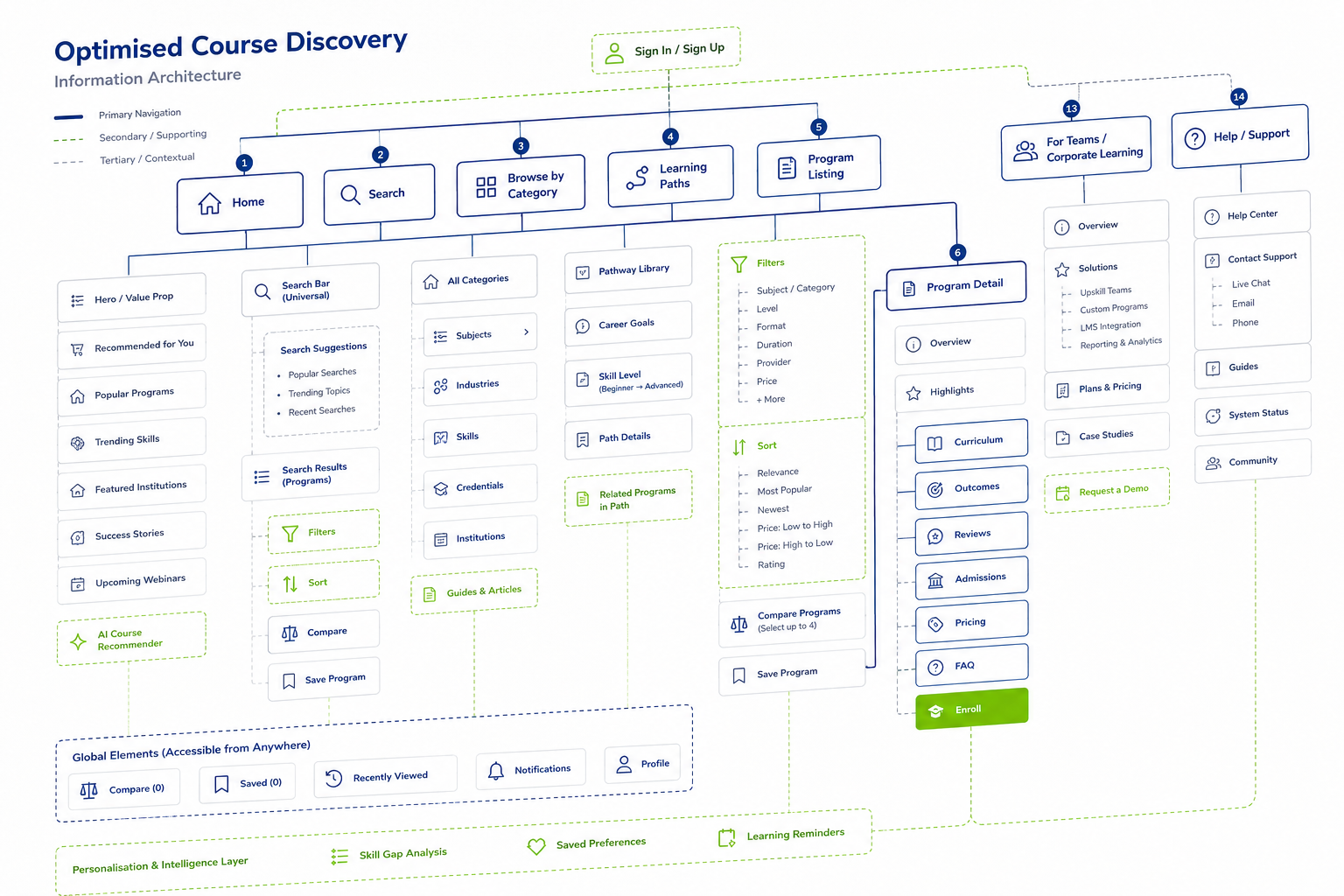
Optimised Course Discovery

Optimised Course Discovery

Improved navigation structure, search functionality, filtering options, and content hierarchy, making it significantly easier for users to find, compare, and evaluate relevant programmes.
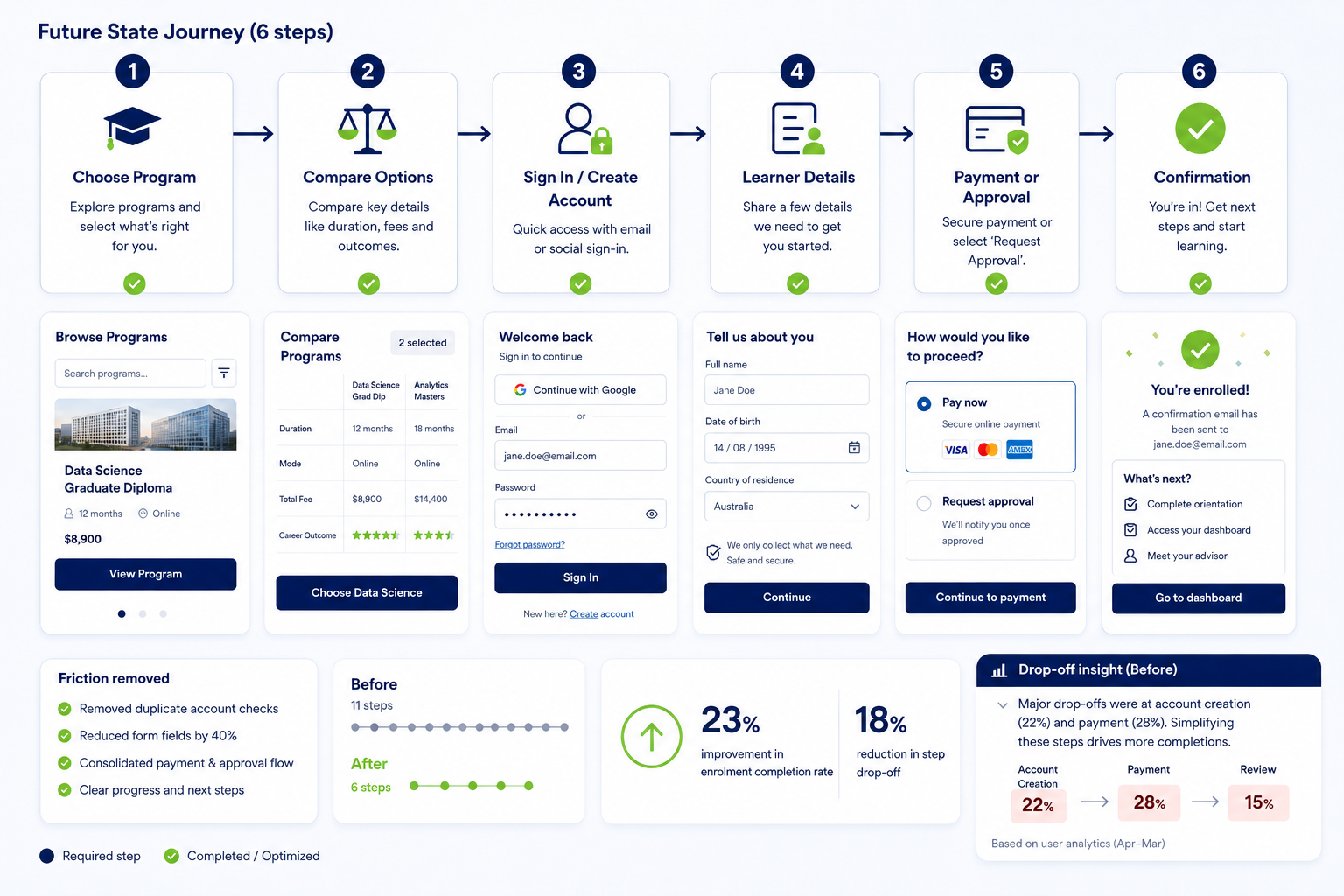
Streamlined Enrolment Flows

Streamlined Enrolment Flows

Reduced friction across critical registration and enrolment journeys by eliminating unnecessary steps and clarifying decision points that caused user drop-off.
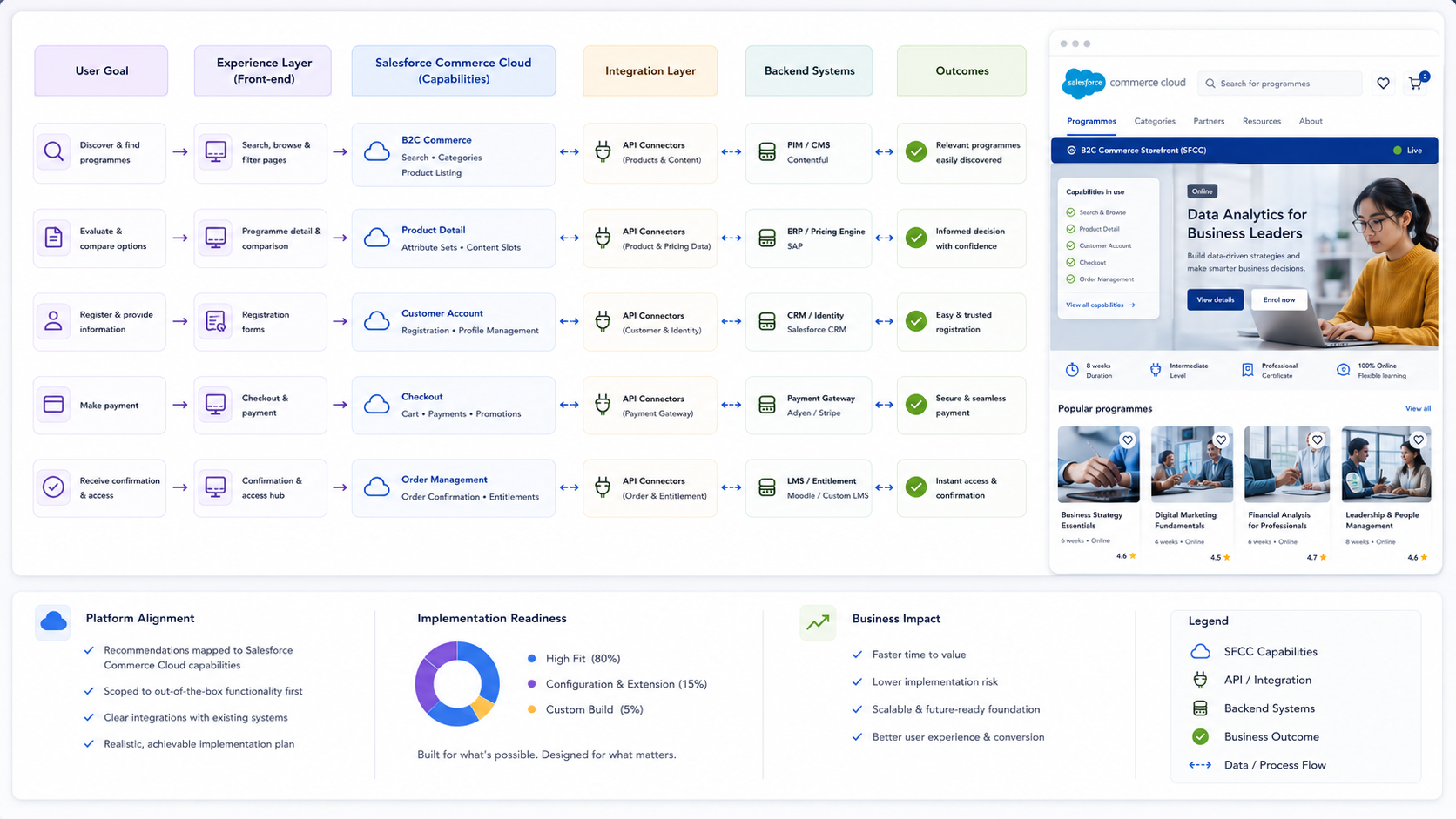
Salesforce Commerce Cloud Alignment

Salesforce Commerce Cloud Alignment

Ensured all recommendations were scoped to platform capabilities and implementation constraints, creating a realistic, actionable blueprint rather than an aspirational redesign.

My Role

Contributions & ownership

Research
  • Research planning
  • Stakeholder interviews
  • Persona creation
Analysis
  • Journey mapping
  • Behavioural analysis
  • Opportunity identification
UX Design
  • Information architecture
  • Flow optimisation
  • Experience recommendations
Collaboration
  • Product teams
  • Marketing stakeholders
  • Salesforce implementation teams

Outcomes & Impact

Results that speak

Improved discoverability — users identified relevant programmes more efficiently
Reduced enrolment friction — optimised flows simplified critical conversion journeys
Stronger audience alignment — coherent journeys for both B2B and B2C users
Future-ready foundation — scalable framework for ongoing storefront enhancements

Reflection

What I learned

Understanding behavioural differences between audience groups is critical when designing shared experiences. Journey mapping became one of the most valuable tools on this project, not just for uncovering friction points, but for aligning stakeholders around user needs in a way that abstract research findings rarely achieve.